
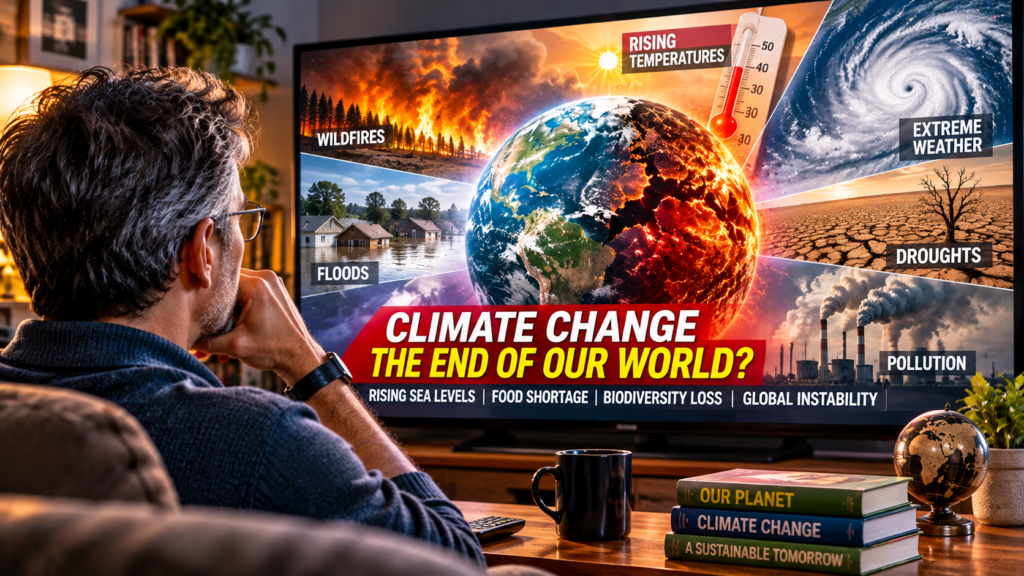
There is something strangely irresistible about the idea that the world might end tomorrow. We know it sounds frightening. We know that most predictions about the apocalypse have failed miserably. And yet, every few years, a new prophecy, an ancient manuscript, a mysterious astronomical event, or a scientific warning sends millions of people searching for answers to the same question: Are we approaching the end of the world?
Perhaps it is human nature. We are curious creatures, fascinated by mysteries, uncomfortable with uncertainty, and secretly drawn towards stories that make our ordinary lives feel part of something much bigger. A prediction about the end of civilisation has a peculiar ability to capture our imagination. It makes us pause, look at the sky, question our existence, and wonder whether the future is as secure as we would like to believe.
From Nostradamus to Baba Vanga, from ancient religious scriptures to modern climate scientists, humanity has never stopped looking for signs of its own destruction. And interestingly, our fascination with doomsday theories seems to be growing rather than disappearing.
But why?
The Prophets Who Never Quite Leave Us Alone
Long before television documentaries, YouTube videos, and social media predictions, people were already trying to decode the future through mysterious prophecies.
One of the most famous names in this world is Nostradamus, the sixteenth-century French astrologer and physician. His book Les Prophéties, published in 1555, contains hundreds of cryptic four-line verses known as quatrains. Some enthusiasts believe these verses predicted major historical events, including wars, political assassinations, disasters, and the rise of powerful leaders.
What makes Nostradamus particularly fascinating is the ambiguity of his writing. His verses rarely provide specific dates, names, or locations. Instead, they offer symbolic descriptions that can be interpreted in several ways. After a major tragedy or political event, people often return to his writings, searching for lines that appear to describe what has happened.
It is almost as if history happens first and the prophecy finds its meaning afterwards.
Then there is Baba Vanga, the blind Bulgarian mystic who died in 1996. Even decades after her death, she continues to attract enormous attention. Numerous predictions are attributed to her, ranging from natural disasters and political upheavals to technological developments and global conflicts.
Some followers claim that she foresaw significant world events. However, many of these claims are difficult to verify because reliable original records are often missing, and predictions are frequently repeated through second-hand accounts.
Still, her popularity tells us something important. People do not necessarily need a prophecy to be scientifically established to find it fascinating. Sometimes, the mystery itself is enough.
And that is perhaps the real secret behind these legendary figures. They offer us a glimpse into a future that we cannot see, understand, or control.
Why Do We Love Being Scared?
Think about the last time you watched a disaster movie. Perhaps it involved an asteroid approaching Earth, an unknown virus spreading across continents, or a mysterious global catastrophe. You probably felt a little anxious, but you also wanted to know what happened next.
Why do we voluntarily expose ourselves to frightening possibilities?
Psychologists suggest that one reason is our attraction to controlled fear. When we read about an apocalypse or watch a film about the collapse of civilisation, we experience danger without actually being in danger. We can explore our deepest fears from the comfort of our homes.
Doomsday theories also give us something that everyday life often lacks: a dramatic story.
Our daily routines are predictable. We wake up, work, pay bills, scroll through our phones, and repeat the same activities. But the possibility of an extraordinary event suddenly changes the scale of our thinking.
A prophecy about the end of the world makes us wonder about humanity, destiny, religion, science, and our place in the universe.
There is also another psychological dimension. Uncertainty is uncomfortable. We want explanations for things we do not understand. When the world experiences a pandemic, an earthquake, a war, or an economic crisis, some people naturally begin looking for larger patterns.
A mysterious prophecy can seem more emotionally satisfying than accepting that certain events are unpredictable.
Perhaps we are not always fascinated by the end of the world itself. Perhaps we are fascinated by the possibility of knowing what comes next.
The Calendar That Was Supposed to End Everything
One of the most memorable examples of modern doomsday hysteria occurred in December 2012.
For years, the internet, television programmes, and popular culture had been discussing an extraordinary prediction supposedly associated with the ancient Mayan calendar. According to the popular interpretation, the world would end on December 21, 2012.
Some predicted massive earthquakes, others expected a planetary alignment, and a few believed that a mysterious celestial object would destroy Earth.
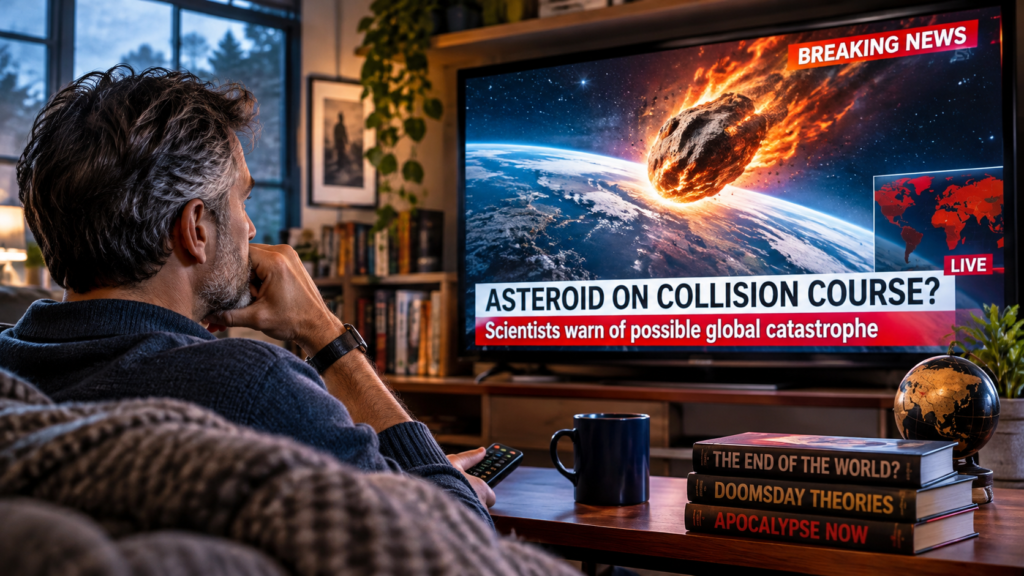
As the date approached, the excitement grew. News channels discussed the possibility, conspiracy theorists published alarming videos, and people around the world wondered whether civilisation was approaching its final chapter.
Then December 21 arrived.
And the world continued.
The misunderstanding was largely based on the completion of a cycle in the Mayan Long Count calendar. It did not mean that the ancient Maya had predicted the destruction of Earth.
Yet the episode was a remarkable demonstration of how easily an uncertain interpretation can become a global phenomenon.
It also revealed something amusing about humanity: we can spend years worrying about the end of the world and then wake up the following morning, make coffee, and get ready for work.
This Time, Some Warnings Are Coming From Science
Here is where the conversation becomes considerably more serious.
Unlike vague prophecies about mysterious celestial events, some of the dangers facing humanity today are supported by measurable scientific evidence.
Climate change is perhaps the most significant example.
Rising global temperatures, melting glaciers, shrinking ice sheets, changing rainfall patterns, rising sea levels, and increasingly intense heatwaves are no longer distant possibilities. They are part of an observable global trend.
The scientific community, including the Intergovernmental Panel on Climate Change (IPCC), has repeatedly warned that human activities, particularly the burning of fossil fuels, are warming the planet.
Consider the implications.
Imagine living in a city where summer temperatures become increasingly unbearable. Imagine coastal communities gradually losing their homes to rising seas. Imagine farmers struggling with unpredictable rainfall, water shortages, and declining agricultural productivity.
These are not scenes from a Hollywood apocalypse. They are real challenges already affecting communities across the world.
And climate change is only one part of the picture.
We also face other serious risks:
- Nuclear conflict: Modern nuclear weapons have the potential to cause catastrophic destruction, with consequences extending far beyond the countries directly involved.
- Artificial intelligence: While AI offers enormous opportunities, poorly managed systems, malicious applications, and increasingly sophisticated autonomous technologies raise important questions about humanity’s future.
- Pandemics: COVID-19 demonstrated how quickly an infectious disease can disrupt economies, healthcare systems, international travel, and everyday life.
- Biodiversity loss: The destruction of natural habitats and the disappearance of species threaten ecosystems that humanity depends upon.
- Resource scarcity: Growing populations, unsustainable consumption, and pressure on freshwater and agricultural resources could intensify global instability.
None of these developments means that the world is about to end. But they remind us that humanity’s future is not guaranteed.
Perhaps the most unsettling difference between ancient prophecies and modern warnings is that we now have scientific tools to measure some of the dangers we face. We are not simply interpreting mysterious verses. We are examining data, observing changes, and trying to understand the consequences of our own decisions.
The Internet Has Given Doomsday a New Life
A few decades ago, a doomsday prediction might have appeared in a newspaper, a television documentary, or a book. Today, it can reach millions of people within minutes.
Social media has transformed the way we consume frightening information.
A video claiming that an ancient prophecy predicts a major disaster can attract millions of views. A photograph of an unusual cloud formation can become evidence of an approaching catastrophe. A scientific report about rising temperatures can be presented in a dramatic video with ominous music and a headline announcing that humanity has only a few years left.
Algorithms tend to reward content that attracts attention. Fear, surprise, controversy, and mystery are powerful ingredients for engagement.
The result is a strange information environment where genuine scientific warnings, historical predictions, religious interpretations, conspiracy theories, and completely fabricated stories often appear side by side.
For an ordinary viewer, separating facts from fiction can become surprisingly difficult.
And perhaps that is why doomsday theories have become such a successful form of digital entertainment.
Every new prediction gives us another mystery to investigate, another video to watch, and another reason to ask strangers on the internet what they think.
Are We Actually Afraid of the End of the World?
There is an interesting contradiction in our relationship with doomsday theories.
On one hand, we are terrified of the possibility that humanity might disappear. On the other, we seem almost entertained by the idea.
Perhaps the deeper fear is not death or destruction itself, but the loss of everything familiar.
Our families, friendships, ambitions, memories, cities, and the little routines that make life meaningful could all be threatened by a global catastrophe. The thought is overwhelming.
Yet there is another reason we keep returning to these stories: they remind us that life is precious.
When we imagine a world without tomorrow, today’s ordinary moments suddenly acquire a different meaning. A conversation with an old friend, a family dinner, a beautiful sunset, or a quiet morning becomes something worth appreciating.
In a strange way, stories about the end of the world can make us think more deeply about how we live in the present.
Perhaps that is their hidden appeal.
The World Has Survived Many Ends Before
Human history is full of predictions about impending destruction. Civilisations have risen and fallen. Empires have disappeared. Wars have devastated continents. Diseases have killed millions. Natural disasters have changed the course of history.
And yet, humanity has continued.
We have survived extraordinary challenges through innovation, cooperation, scientific discoveries, and an ability to adapt to changing circumstances.
This does not mean that we should dismiss every warning or assume that everything will somehow work out. Blind optimism can be just as dangerous as unnecessary panic.
But neither should we surrender to every alarming prediction that appears on our screens.
Nostradamus may continue to intrigue us. Baba Vanga may remain a fascinating figure in popular culture. Ancient calendars and religious texts will continue to inspire interpretations about humanity’s destiny.
But our future will also depend on decisions being made today by governments, scientists, businesses, communities, and ordinary individuals.
The climate crisis, technological disruption, international conflict, and environmental destruction deserve serious attention, not because an ancient prophet supposedly predicted them, but because there is evidence that our actions can influence their outcomes.
Perhaps the Real Mystery Is What Happens Next
Maybe the reason we love doomsday theories is that they bring together two of our strongest human emotions: fear and curiosity.
We want to know whether the world will end, but perhaps we are even more curious about what humanity will become.
Will we learn to live sustainably? Will artificial intelligence transform civilisation beyond recognition? Will we find ways to protect our planet? Will future generations look back at our current struggles as a turning point in human history?
Nobody really knows.
And perhaps that is what makes the future so fascinating.
The next time someone shares a prophecy predicting the end of the world, take a moment to explore it. Read about Nostradamus. Look into Baba Vanga’s alleged predictions. Explore ancient civilisations and their beliefs about the end of time.
But also read about climate science, technological developments, environmental protection, and the challenges facing our planet.
Because there is a difference between fearing the end of the world and understanding the risks that could shape it.
And if there is one thought worth remembering, it is this:
“The greatest threat to tomorrow may not be what the prophets predicted, but what we choose to ignore today.”
Perhaps the world does not need another prediction about its final day. Perhaps it needs a little more wisdom about how to protect the days it still has.